An Expert Review of the Watercolor Scattered Leaves Tumbler Graphics
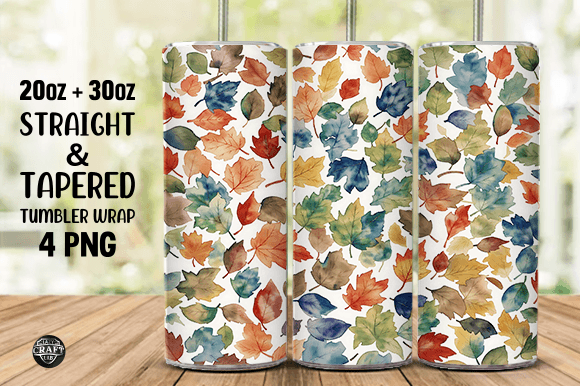
As a designer, my first impression upon opening the Watercolor Scattered Tree Leaves Tumbler file was one of organic serenity. This isn’t a rigid, technical asset; it’s a soft, expressive illustration. The scattered arrangement and gentle watercolor texture immediately suggest a mood of relaxed elegance, natural charm, and artful craft. It represents a style that leans towards handmade businesses, boutique brands, and any project wanting to communicate authenticity and a connection to nature.
Where This Design Asset Shines in Real Client Projects
Imagine you’re developing a visual identity for a small pottery studio, a seasonal launch for a herbal tea company, or the packaging for a local artisan’s handmade soap line. This tumbler wrap graphic transcends its nominal use. Its core strength lies in its versatility as a decorative accent. In such a project, these scattered leaves can become the unifying visual thread.
For brand identity, the elements can be extracted to create custom patterns for product labels, tissue paper wrap, or website backgrounds. For social media graphics, they provide a ready-made, beautiful frame for Instagram posts announcing a new product line or Pinterest pins highlighting a “maker’s process.” The watercolor bleed and soft edges make it ideal for merchandise design like tote bags and t-shirts, where a softer, artistic feel is desired over a hard-edged logo.
Practical Applications: From Mockups to Campaigns
In large layout areas, such as a poster for a fall farmers’ market or the hero graphic on a boutique’s homepage, the scattered leaves fill space with interest without overwhelming the core message. They work exceptionally well in product mockups. Placing this design on a skinny tumbler, as intended, creates an instantly professional presentation for an Etsy shop or print-on-demand listing. Furthermore, it can anchor a themed collection—think a series of blog visuals, digital ads, or printable wall art for a “forest retreat” themed editorial.
It’s a superb asset for supporting brand elements rather than being the primary logo. It adds depth and texture to a marketing visual, making a simple text announcement feel more curated and complete. For crafters and Cricut users, the scalable nature (assuming vector files are included) makes it perfect for creating custom stickers or decorative elements for handmade greeting cards, elevating a personal project to a commercial-ready printable design.
Navigating Potential Limitations with Professional Judgment
Every graphic design asset has its optimal context. The Watercolor Scattered Tree Leaves Tumbler design should be used carefully in situations demanding very clean visual hierarchy. Its detailed, scattered nature means it can become visually noisy in crowded layouts or when used at very small sizes, like on a business card or as a tiny icon. The soft watercolor tones may also struggle with low-contrast designs or on complex, patterned backgrounds where the subtlety gets lost.
This asset is not inherently suited for minimalist branding or stark, professional corporate materials where clarity and bold simplicity are paramount. Its emotional appeal is its strength, but that same emotion might clash with a brand needing to project strict modernity or technical authority.
Impact on Readability, Trust, and Final Polish
When integrating this asset, its effect on readability is crucial. Overlaying text directly onto the densest areas of leaves will challenge legibility. A professional approach is to use the graphic as a border, a side element, or on a layer with reduced opacity behind clean, well-spaced typography. I’ve tested it paired with a crisp sans-serif font for modern contrast and a gentle script font for harmonious blending; both work, but the layout must be intentional.
For brand consistency, this design can establish a warm, trustworthy tone. It signals craftsmanship and attention to detail, which can enhance visual trust with an audience seeking authenticity. This directly boosts audience engagement in sectors like handmade goods, eco-friendly products, or lifestyle blogging. The overall impression it lends to a project is one of artistic polish—it moves a design from generic to thoughtfully composed.
Essential Designer Checks Before Client Use
Before committing this asset to a real client’s commercial design project, a few practical tests are non-negotiable.
- Test in Black and White: How do the leaves hold up without color? This checks the fundamental strength of the composition for applications like cost-effective printing.
- Check Contrast on Light & Dark Backgrounds: Preview it on both white and dark substrates. The watercolor transparency may require a slight background adjustment for optimal visibility.
- Preview at Small and Large Sizes: Does it retain its character when scaled down for a sticker, and does it remain crisp when blown up for a poster? This speaks to the file’s technical quality.
- Place on Real Mockups: Don’t just look at the flat file. Apply it to a tumbler mockup, a t-shirt template, and a book cover to see how it interacts with real-world shapes and shadows.
- Review File Formats & Editability: Confirm you have the necessary files. An SVG allows for infinite scaling and color editing for Cricut projects or logo design adaptations. A high-resolution PNG with clean transparency is key for web design and social media graphics.
- Confirm Commercial Licensing: This is paramount. Ensure the license explicitly permits use in client work and for physical products like packaging design and sublimation design for sale. Never assume.
Finally, test print quality at home if possible. The subtle gradations of a watercolor design can sometimes flatten or blot in certain print processes. Knowing this ahead of time saves client revisions.
The Final Verdict for Your Creative Marketplace
The Watercolor Scattered Tree Leaves Tumbler is more than a tumbler wrap; it’s a versatile illustration that brings a specific, gentle aesthetic to a creative design toolkit. It fits projects where emotion and artistry are part of the brand message. For designers servicing handmade businesses, small business branding in natural niches, or digital sellers building cohesive visual campaigns, this asset can be a powerful, time-saving foundation. Used judiciously—with attention to hierarchy, scale, and licensing—it elevates a concept from a simple idea to a professionally realized design asset, ready for the market.